

There are no questions on our minds here at The next platform that quantum computing will, in a way, be part of the workflow to solve some of the most complex computational problems the world can think of.
What we doubt is whether anyone can make money from quantum computing. It won’t be a bulk product and it won’t be cheap either. Of course, the costs will likely be only a fraction of the value of the benefits derived from quantum computing, like in the HPC simulation and simulation business, but neither does the HPC business. exceptional returns over the past six decades.
Now it’s AI training and inference on a large scale – that’s a different story altogether. And we’re not writing that article today – and on purpose because, to be honest, like AI poisoning. We’ve probably all suffered from AI poisoning at this point. Let’s sigh together. . . .
So, nothing, we’ll talk about the quantum computing market and see if there’s any consensus on what it is, how big it is, and how important it is.
What got us thinking about this in the first place was an IDC report a few weeks ago that covered the worldwide quantum computing market and we found that the market researchers there calculated that Quantum computing drove $1.1 billion in revenue in 2022 and will grow. at a compound annual growth rate of 48.1% to reach $7.6 billion by 2027. To us, this isn’t a huge amount – it’s about the same cost as the company. eight AI training machines capable of training GPT-4 or maybe double the number of exascale class supercomputers for national HPC centers with great national security discounts. That’s not all in the crazy scheme of things.
The irony is that since attention has now been focused on innovative AI — yes, we won’t talk about that — IDC has actually cut its quantum computing forecast a bit. In their final market forecast made in November 2021, they predicted that the quantum computing market will grow from $412 million in 2021 to $8.6 billion in 2027, reaching a CAGR is 50.9% for 6 years. It’s not a huge boost to growth – several billion dollars in the region are expected in those years – but the revenue generated in 2027 for quantum computing is really just a drop. water in the barrel for such a transformative information technology. Global IT spending will be around $4 trillion by 2027.
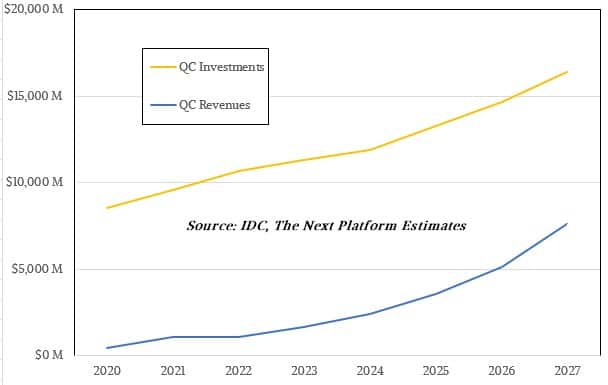

We know how to calculate the CAGR and do it backwards and forwards from the data that IDC put out in the two quantum computing revenue forecasts, then we take what they say about investing in electricity. where is the quantum math and spending end point for 2027 and do reverse CAGR to figure out the investment in 2021 and 2023 and fill in some estimates for 2020 and 2022 and then plot that data. We’re not saying this is exactly what IDC would say, but it’s close enough to be illustrative.
Basically, the level of investment in quantum computing technology over the past few years has been 20X in 2020 to about 10X in 2021 and 2022, but will drop to 2.2X in 2027. That is a good curve. , but it also shows you that the expected revenue generated from quantum computing will not cover the investment costs. This happens when a technology is young and also when it is a technology that is difficult to adopt widely. This reminds us of the high-end HPC of the past several decades, which was really supported by the need to manage nuclear weapons and ensure they remain operational. Throw all that away, and HPC probably won’t pay for itself – despite all the good it actually does in the world.
Oliver Tonneau, partner at venture firm Quanto Nation, which invests in quantum computing projects around the world, presented at the HPC User Forum last fall and took this chart from Quantum insider detailing the different types and amounts of investments in quantum computing technology:


And Tonneau provided this chart to show investment levels in North America and Europe


The analysis by quantum device type is interesting. We’re not going to go into that right now. We’re just counting the money.
Come to think of it, this chart by Tonneau is also fascinating:


China seems pretty serious about quantum computing, at least on a monetary basis. Money is not always spent wisely and efficiently when a country is in catch-up mode. However, money has a way of making progress and markets appear.
This is how the folks at Hyperion Research, who were part of the IDC consortium before it was acquired by a Chinese company (and a national security risk in selling to that company), see the market. quantum computing field in terms of revenue.


This seems much less exciting than what IDC is talking about in the data above.
And here’s a very interesting chart showing quantum computing hardware companies by country and different quantum device modalities being considered by quantum computer designers:


As of last fall, there were 44 different suppliers of quantum computing hardware and dozens of different ways to generate qubits.
Heaven only knows how things will turn out. Maybe we can ask a quantum computer to figure it out?
#big #small #quantum #computer #racket

 World Innovations: Top Trends Shaping the Future Worldwide
  Global Migration Trends: Understanding the Modern Movement of People
  World Sports: Discover the Most Exciting Global Sporting Events