

Is Valve building a convenient living room PC capable of powering wireless VR?
Evidence of a new AMD APU for Valve was found in a Linux driver, a hint in a Steam driver found by YouTuber SadItsBradley and his Discord dataminers, and an almost forgotten discovered in Valve HQ suggests that may have been the company’s plan. For Valve, it could make a lot more sense than a completely independent approach.
Thanks to SadItsBradley for pointing us to the evidence he and others have discovered.
Valve is definitely building some kind of headset
Valve previously confirmed that they are working on a new VR headset. In December 2021, more than a year after the launch of the Index, Valve President Gabe Newell said the company was “making a big investment in the new headset”.
In October 2022, Valve posted a job opening for a computer vision engineer to help “prototype, ship, and support” VR headsets for “millions of customers worldwide.”“, with inside-out tracking, camera pass-through, environmental understanding, eye tracking, and hand tracking. Most recently, in December 2022, Valve product designer Greg Coomer told a Korean gaming news magazine that the company was recently “working on a new VR headset” and that there are “several projects being worked on internally”.
But is it powered by a Unified PC?
The Steam Deck handheld computer uses a custom AMD APU named Van Gogh – the APU is a single chip that combines a CPU and GPU to save power and costs, a similar approach used by consoles like the PlayStation and Xbox uses.
The Steam Deck was codenamed “Jupiter” during development and the Van Gogh APU was codenamed “Aerith”.
Last week Linux news site Phoronix noticed a new Valve device codenamed “Galileo” with a new APU codenamed “Sephiroth” added to the Linux audio driver.
Back in February, data miner Razzbow discovered “Galileo EV2” in the Steam Deck firmware – EV2 stands for Engineering Validation, the stage after the design stages, before the product is shipped. ready for mass production.
The device is said to have a proximity sensor and a small circular touchscreen, both of which are not included in the Steam Deck and are not expected in a refreshed model – and Valve recently said knowing the next-gen Steam Deck will actually be “years away” .
YouTuber SadItsBradley and his Discord data mining team have been searching for and uncovering evidence of Valve’s future VR plans for two years now. Early findings suggest the headset will support a ‘VRLink’ wireless feature, similar to Quest’s Air Link but where the PC creates a wireless hotspot instead of going over your local Wi-Fi network. That’s the first hint that the headset could be paired with a companion console, since most desktops don’t have a wireless chip for this.
A few months ago there was a new Steam sub which was basically game packs that could be added to an account by activating a game key for testing developer Press/Valve
The first game added to the sub was Half Life: Alyx, along with many other VR titles. More added today pic.twitter.com/OQdHanA7YP
– Brad Lynch (@SadlyItsBradley) September 8, 2023
Lynch’s team recently discovered a recently created Steam spinoff – a collection of games – created by Valve, in which the first title added was Half-Life: Alyx, along with many more. Other VR games. On Friday, Valve added more games, still in VR. Valve created a similar subchannel when Index launched to showcase recommended games to the press and testers. Many of these titles require PC power and simply cannot run on mobile headset chipsets.
His team also found references to a “Screen Sharing” function, as well as the ability for SteamOS devices to update the headset’s firmware remotely over a local network. All of these discoveries hint at a dual architecture with a simple PC running SteamOS rather than a fully standalone headset.
This living room console PC could have been discovered almost four years ago – and the design and patent could provide clues as to why Valve’s firmware says the Galileo has a screen circular touch.
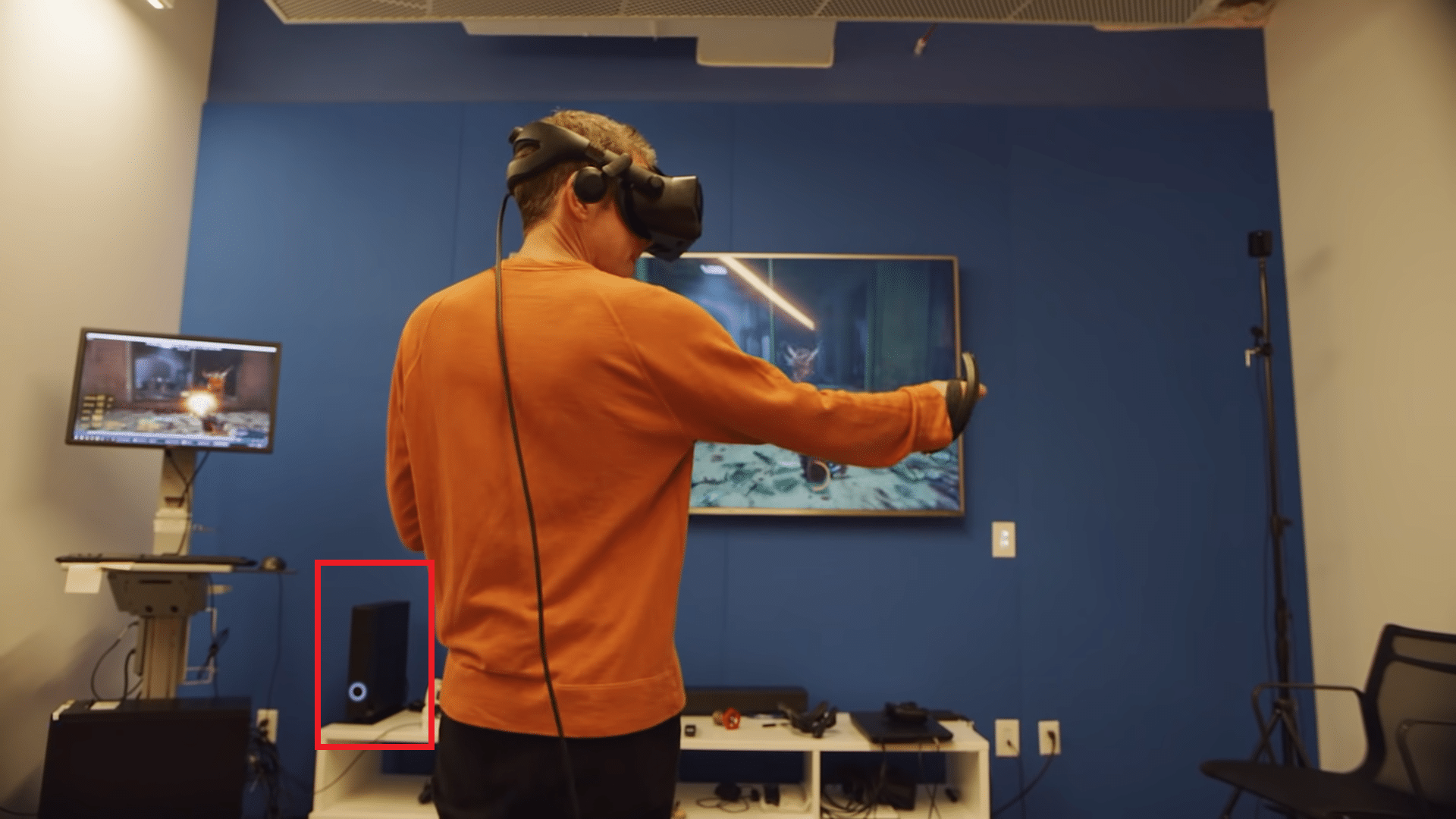
When Valve launched the Half-Life: Alyx demo in late 2019, people saw what appeared to be a secure PC next to a TV, in the demo room at Valve HQ. That can be clearly seen in Geoff Keighley’s The Final Hours of Half-Life: Alyx — Behind Closed Doors at Valve, for example.


In this iteration of the device, it’s unclear whether the circular feature is just a lighted power button or not.
But in a Valve patent found by Lynch’s team, a surprisingly similar device was described, with a circular screen activated when the user gets close via a proximity sensor – to be exact. what Galileo’s firmware suggests.
It would make perfect sense for Valve
Controlling a headset with a conveniently equipped PC would make much more sense to Valve than a fully standalone Quest-style headset.
The Steam Deck can play most PC games because it has an 800p display, meaning it has to use less than half the pixels of a 1080p display. But this trick is not applicable to VR – standalone headsets have no fundamental difference in screen resolution compared to PC headsets.
The vast library of VR content available on Steam is designed to run on gaming PCs, draw hundreds of watts from a wall outlet, and is cooled by multiple large fans. Battery-powered mobile chipsets cannot achieve this level of performance. For example, even Qualcomm’s upcoming next-gen chipset joining the Quest 3 is only about a third as powerful as the GTX 1060 Valve lists as the absolute minimum for Half-Life: Alyx. The gap between PC and mobile chipsets is still huge.
For Valve to take a completely independent approach would likely require creating a separate SteamVR store for the headset, with games ported separately like those for Quest and Pico. Or at least, developers will have to create a new ‘Ultra Low’ quality setting.
But beyond being confusing, this would be contrary to Valve’s entire ethos towards VR to date. Gabe Newell has repeatedly said that the limitation of VR is the quality of the experience, not the price. For example, here’s what Newell said in 2017:
“If you take existing VR systems and make them 80% cheaper, there still isn’t a huge market.
“We really think that if anything, most of the interesting things will happen at the high end. That we’re really limited in resolution, we’re limited in CPU, we’re limited on GPUs. That’s where it gets interesting.” things will happen, not at the low end of the market. Once you have it, once you have something and you can say okay, this is something that millions of people are excited about, then you start worrying about keeping costs down.”
Isn’t a steam engine a thing?
You’d be right to point out that Valve has previously released a series of full-fledged PCs running SteamOS, branded Steam Machines.
But they are designed and sold by third-party manufacturers, mostly using off-the-shelf PC parts. Those companies need to make a profit on the hardware, leading to higher prices compared to consoles that don’t have a clear advantage.
But Valve owns the Steam platform, from which it generates most of its revenue. So, like the Steam Deck, Valve can sell hardware close to or even below production costs – offering hardware prices that are competitive with consoles.
Steam Machines also predated Proton by many years, Valve’s compatibility layer that allowed Windows games to run on Linux-based SteamOS. Allowing access to countless Windows-only games on Steam would change the value proposition significantly.
However, there is contrary evidence
In contrast to this web of evidence, there are comments from Gabe Newell referring to “integrated wireless VR” and “transportable”.” earphone.
In February 2022, Newell told Edge Magazine that Steam Deck’s mobile approach is a stepping stone to VR:
“One of all [Deck] represents high-performance, battery-capable horsepower that you can finally use in VR applications. You could take a PC and build something much easier to transport. We haven’t really reached our goal yet but this is a stepping stone.”
Newell’s specific reference to “battery capable” and “transportable” seems to contradict the idea of a computing device being plugged into a wall outlet in your home.
Later that month, Newell described the idea of an “integrated wireless VR solution” to Eurogamer:
“You know, all of these things are related, right? A lot of the technologies that we might be using and their future versions come from technology that we have to develop.” And then if you flip it around and you look at it like a high-performance mobile PC gaming device, you say, why can’t I have that in a VR solution? Wireless integration?
These statements from Newell strongly suggest a completely independent headset. However, the mention of “not really being achieved yet” could suggest that it’s just Valve’s ultimate goal, with the technology not quite ready in the near term to deliver high-fidelity VR High.
In any case, Valve will likely launch soon
Last week, a new Valve device passed through Korea’s Radio Research Agency, the government agency responsible for certifying electronic devices with wireless capabilities. The listing doesn’t reveal much, other than that it supports 5 GHz Wi-Fi, which makes it unlikely to be a controller.
The device has a model code of 1030. Valve Index has a code of 1007 and Steam Deck has a code of 1010.
Maybe this is just Steam Deck Pro, Steam Deck OLED, or some other version of Steam Deck. But with the Index now over four years old and the release of Meta Quest 3 imminent, can we build to a Valve VR hardware reveal?
#Valve #unified #power #headset

 World Innovations: Top Trends Shaping the Future Worldwide
  Global Migration Trends: Understanding the Modern Movement of People
  World Sports: Discover the Most Exciting Global Sporting Events