

Rokid recently announced new AR glasses with a gesture-based user interface similar to Apple’s Vision Pro.
Rokid has been designing smart glasses and AR headsets for many years and has developed its own operating system for manipulating virtual controls and navigating AR apps. Known as YodaOS, it recognizes micro-gestures of the hand, including pinching, similar to the one shown in Apple’s VisionOS demonstration.
Studio AR Rokid
Rokid’s new system is called AR Studio, a pack of Rokid Max Pro AR glasses and a Rokid Station Pro compute module. This combination is reminiscent of the Rokid Max + Station package we tested recently.
What makes AR Studio even more versatile is the simultaneous mapping and mapping (SLAM) technology built into the Rokid Max Pro glasses as well as the processing power of the Rokid Station Pro.

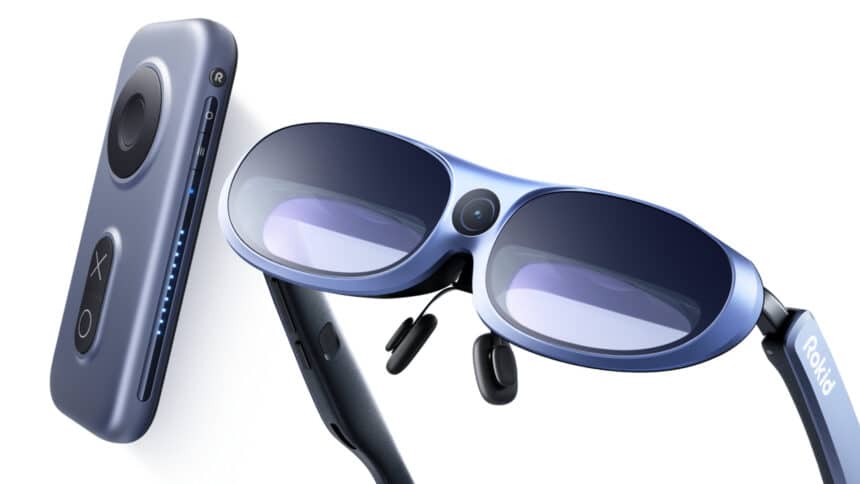
Rokid AR Studio includes Max Pro and Station Pro glasses. | Image: Rokid
Rokid AR Studio can track the movements of the head, hands and nearby objects. The system can use this information in apps and games, just like VR headsets.
Specifications of Rokid AR Studio
The screen specifications of the Max Pro glasses are quite similar to those of the Rokid Max – 1080p resolution with 600 nits brightness, 50-degree viewing angle (FOV) and 90 to 120Hz refresh rate. That creates a virtual screen as large as a 215″ TV when viewed from 6 meters away.
Rokid’s Max Pro goes beyond smart glasses with a centered camera that calculates depth and tracks movement. Rokid claims centimeter accuracy with its deep learning algorithm.
The wearer’s head and hands are tracked in 3D with six degrees of freedom to perceive angles and positions, enabling interaction with YodaOS and AR apps.

Rokid’s YodaOS looks similar to Apple’s Vision Pro operating system. | Image: Rokid
Rokid Station Pro is a pocket-sized external computing module that connects to Max Pro glasses to provide power, process sensor data, run apps, and feed video to the display.
It contains Qualcomm Snapdragon XR2 + Gen1, 12 GB memory, 128 GB internal storage and fan for active cooling. Based on those specs, CPU and GPU performance should be similar to Meta’s Quest Pro.
Glass form factor
Rokid’s AR Studio comes in the form of glasses, providing see-through AR with good clarity of the actual environment. Sharp graphics are superimposed.
The experience won’t be as rich as the mixed reality pass-through presented by a VR headset because the FOV is limited to 50 degrees. Most VR headsets have a FOV that’s twice as large.

Rokid AR Studio presents a large screen and head and hand tracking. | Image: Rokid
Existing VR headsets struggle with pass-through fidelity, while Rokid Pro Max’s see-through view will be as sharp, stable and colorful as the real world. However, the Pro Max glasses use birdbath optics, which makes vision a bit blurry while dark graphics can look blurry. There are pros and cons to each method.
Pricing and Availability
Rokid’s AR Studio debuts in China for the first time but will be available elsewhere in the coming months. The current price is unknown.
Once limited to business users, the mixed reality and AR markets will soon become more appealing to consumers. Meta’s Quest 3 will be out in a few weeks, Apple’s Vision Pro will launch in early 2024, and Rokid AR Studio could reach other markets within a few months.
All three sound interesting, but we’ll have to wait for real-world experience to see how well each AR/mixed reality solution performs, the depth of the ecosystem, and which solutions deliver value. best overall.
#Rokids #glasses #Apples #Vision #Pro

 World Innovations: Top Trends Shaping the Future Worldwide
  Global Migration Trends: Understanding the Modern Movement of People
  World Sports: Discover the Most Exciting Global Sporting Events